Lies have an expiration date.
No matter how perfectly you perform, no matter how carefully you keep the story straight, "that day" will eventually come. The day the child learns the truth. The day they realize the rental father is not their real father.
I have been doing this work for over 20 years. During that time, I have experienced "that day" many times.
Not every ending is beautiful. Anger, sadness, betrayal. The truth is not kind. But it must be faced.
Keeping the Secret
The hardest part of being a rental father is not the acting.
It is keeping the secret.
Looking into a child's eyes and saying "I'm your dad," while knowing somewhere inside that it is a lie. Maintaining that duality for years, for decades. The psychological toll is greater than you can imagine.
I am "father" to 35 children. I carry 35 secrets. If even one leaks, that family's world crumbles.
So I am meticulous. I never mix up names. I manage schedules rigorously. I never mention one "family" to another. I avoid social media. I keep photographs to a minimum.
But no matter how careful you are, secrets gradually unravel. The longer the time, the more they fray.
The Day the Truth Leaked — Case 1: An Accidental Encounter
One day, I was at a shopping mall with a child from another "family." An 8-year-old girl, her mother, and me. We had come to buy shoes.
Then I heard a voice.
"Hey, that's [girl's name]'s dad!"
I turned around. A child from a different "family" was there — a 10-year-old boy, out shopping with his mother.
The blood drained from my face.
Two children, both calling me "Dad." But they are not siblings. Different surnames. Different addresses.
Fortunately, the boy's mother immediately grasped the situation. "Oh, sorry, wrong person," she said, pulling the boy away. "But that is Dad!" he protested as she led him off.
Later, I told the boy: "There was someone who looked like Dad, right? There are people in the world who look alike."
Whether he was convinced, I honestly don't know. From that day on, I became even more rigorous about schedule management.
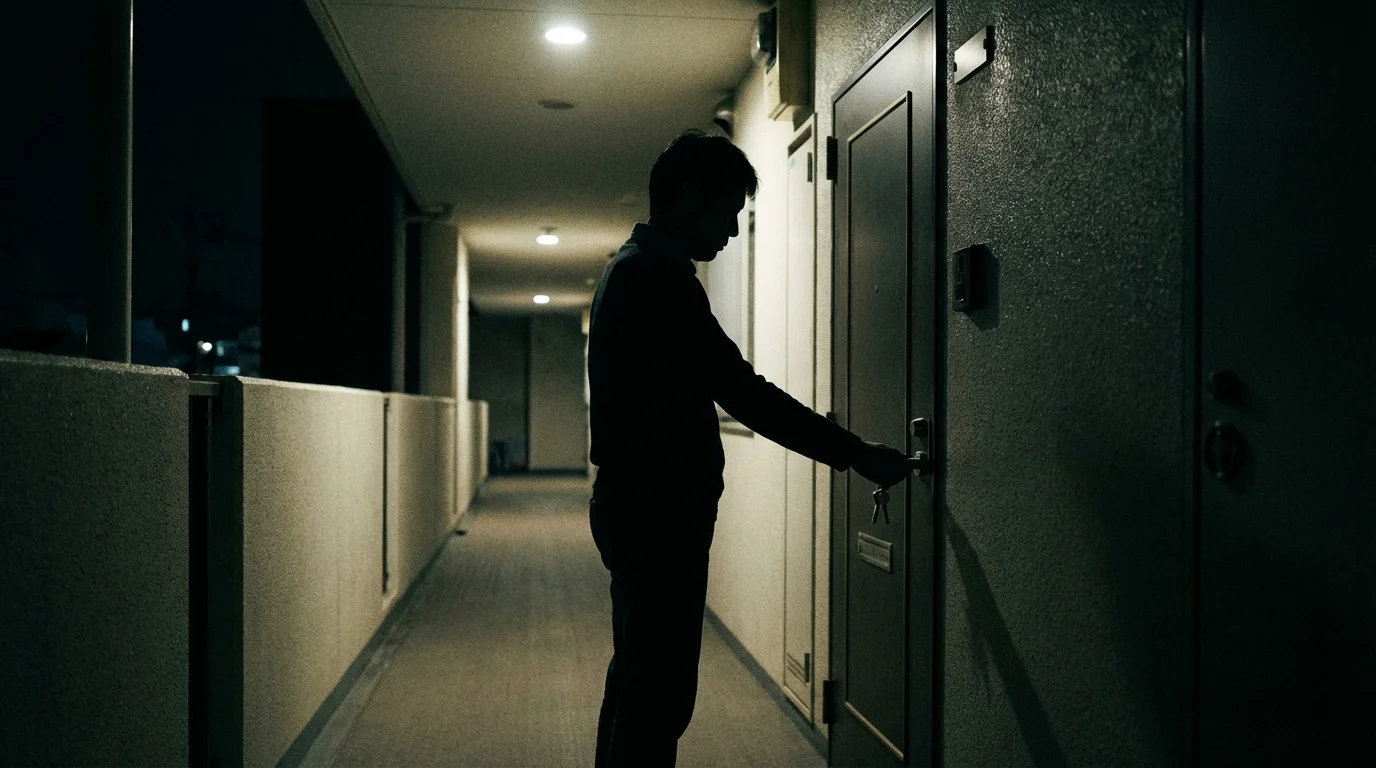
Secrets eventually unravel in unexpected ways
The Day the Truth Leaked — Case 2: The Child Figures It Out
This is the most common pattern.
Children grow. As they grow, they think more logically. Their observation sharpens. And they sense "something is off."
One case involved a 17-year-old girl. I had been her "father" for 10 years. One day, she said:
"Dad. I know."
I didn't ask what she knew. I could tell from her eyes.
"Since when?" I asked.
"Since eighth grade. I found a Family Romance contract in Mom's drawer."
For three years, she had known. Known, and kept silent. She didn't want to hurt her mother. And she didn't want to break her relationship with me.
"Are you angry?" I asked.
"I was at first," she said. "But then I thought about it. If you hadn't come, my life would have been much lonelier. Sports days, parents' days — I would have been alone. So I'm grateful."
I couldn't say anything. I just cried.
The Day the Truth Leaked — Case 3: Anger and Rejection
Not every case ends peacefully.
A 15-year-old boy saw my exchanges with his mother on her smartphone. "I'd like to confirm the schedule for next month's meeting." "This month's fee is XX yen." — matter-of-fact messages.
The boy was furious.
"It was all a lie!" "You were paid to do this!" "You never cared about me!"
Nothing I said could reach him. "Get out! Don't come back!" he shouted, and I left.
For three months, I couldn't see him. His mother sent regular updates: "Still angry." "Won't go to school." "Stays locked in his room."
Three months later, his mother called. "He says he wants to see Mr. Ishii."
At our reunion, he was crying. "I'm sorry," he said. "I'm sorry too," I said.
Since then, our relationship has changed. Not "father and son," but "older friend and younger friend." Yet he still comes to me for life advice. The form changed, but the connection didn't disappear.
"When the truth comes, all I can do is not run away. Take responsibility for the lie. Accept the child's anger, their sadness, head-on. That is the bare minimum of honesty a fake father can offer."
— Yuichi Ishii
Preparing for "That Day"
I encourage every "family" to prepare for "that day."
Specifically, I work with the mother to create a "disclosure plan."
When to tell. How to tell. Who tells. How to support the child afterward.
The ideal timing is after the child turns 18 — when they are emotionally mature enough to process it independently. But reality doesn't always follow the plan. Sometimes it leaks by accident. Sometimes a third party reveals it.
That's why preparation "for whenever it happens" is essential.
I ask each mother to write a "letter" for her child. Why she hired a rental father. How much she loves the child. An apology for the deception. All written honestly.
I, too, have prepared a "letter" for each child. For the day they may read it.
The Ethics of a Long-Term Lie
"Is it ethically right to lie to a child?"
I have confronted this question hundreds of times. Journalists, scholars, counselors, and myself. Everyone asks the same thing.
The answer is not simple.
On one hand, a lie is a lie. It violates the child's "right to know." Knowing one's roots is a fundamental human right. Denying that, even with good intentions, may be unforgivable.
On the other hand, the reality of "having no father" is also cruel. The suffering of being different, of not being "normal." Is lying to prevent that truly wrong?
Even in adoption, origins are sometimes hidden. Children born through sperm donation may grow up never knowing the donor. Society has not yet settled the question of what "real parents" truly means.
My work sits at the very front line of that question. No answer emerges. But we must never stop asking.

The line between lie and truth is not as clear as we think
What Happens to the Child's Trust?
Will a child who learns the truth lose faith in people?
The concern is valid. Their closest "father" was a lie. It's natural to think: "Maybe other relationships are lies too."
In fact, immediately after learning the truth, many children do develop a kind of "distrust of people." They avoid their mother. Suspect their friends. Don't believe what teachers say.
But in my experience, time heals most cases. Three months, six months, a year — gradually, the child comes to understand that "there was truth within the lie."
"Dad" was fake. But the time we spent playing together was real. The cheering at sports day was real. The birthday celebrations were real.
The "form" of the relationship was a lie. But the "substance" of the relationship was real. Children eventually understand that difference. At least, that's what I believe.
My Philosophy — The Emotions Are Real
"If the relationship is a lie, are the emotions a lie too?"
My answer is a clear NO.
When a child says "I love you, Daddy," that emotion is real. Rental or not, the child loved me as a father. That love is not a lie.
When I felt joy at a child's growth, that joy was real. Even in a relationship that began with a contract, you cannot manufacture emotions by contract. Emotions arise naturally.
We cry watching movies. Those are "fictional stories." But the tears are real. Emotions arise regardless of whether the situation is true or false.
The same applies to rental fathers. The relationship may have started with a contract. But the emotions born within it are not written in any contract. They emerged naturally, organically, between two human beings.
So I want to tell each child: "The relationship may have been a lie. But the emotions were real. My caring for you was never, not once, a lie."
"Even if the relationship is fake, the emotions are real. Just as we cry at movies, a child's 'I love you, Daddy' directed at a rental father is not a lie. Emotions know no distinction between real and false."
— Yuichi Ishii
Conclusion — The Resolve to Face the Truth
Someday, all 35 children will learn the truth.
When that day comes, what will I do?
I will not run. I will not hide. I will not make excuses.
I will simply tell them honestly: "I am not your real father. But I truly cared about you. That, at least, was never a lie."
I may be raged at. I may be rejected. I may never be allowed to see them again.
Even so, I will not regret having been part of their lives.
Because even within the lie, there were real moments.
Moments of laughing together. Moments of crying together. The weight of a child on my shoulders. The warmth of a hand in mine. The sound of being called "Dad." All of it was real. Whatever the truth may be, those moments will never disappear.
"The truth is cruel. But within the lie, there is also truth.
— Yuichi Ishii
Emotions do not lie. That alone is my salvation."